
Cirsium arvense (Asteraceae) Creeping Thistle, Canada Thistle
- Das K

- 1 day ago
- 5 min read
Cirsium arvense, commonly known as creeping thistle or Canada thistle, is a perennial herb native to temperate Eurasia and northwest Africa, now naturalized across the globe . It is one of the most successful and persistent weeds in temperate climates, spreading aggressively via an extensive creeping root system . However, this plant of paradoxes is more than just a noxious weed; it has a long history of use in traditional medicine, and modern science is validating its significant phytochemical and pharmacological importance . The plant contains elevated levels of flavonoids and inulin, exhibiting anti-inflammatory, antioxidant, antidiabetic, and antimicrobial properties .



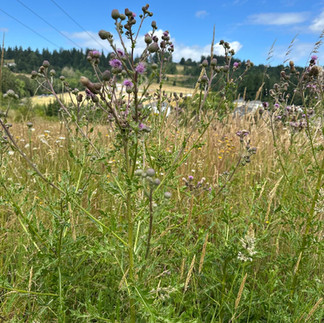

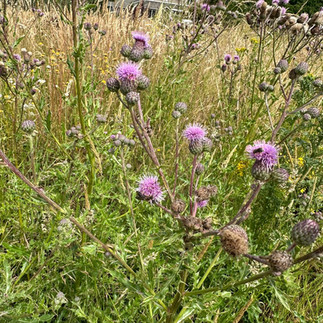

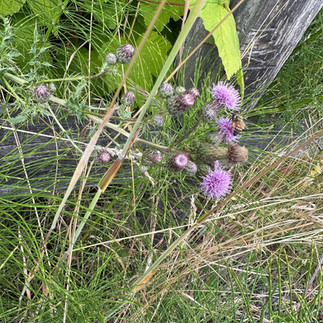
Photographs © Upasana Raj, Portland. Used with permission.
1. Taxonomic Insights
Species: Cirsium arvense (L.) Scop.
Family: Asteraceae
The Asteraceae, or daisy family, is one of the largest families of flowering plants. The genus Cirsium comprises the true thistles, characterised by their spiny leaves and distinctive flower heads. The specific epithet arvense means "of the field."
Taxonomic Note: The species was first described by Linnaeus as Serratula arvensis and later reclassified by Scopoli in 1771 . It is a perennial herb, typically reaching 30–120 cm in height, with a deep taproot and a network of creeping roots that give rise to numerous shoots . The stems are striate and sometimes floccose (covered in woolly hairs) . The leaves are deeply lobed and spiny, glabrous above and often white-tomentose beneath . The flower heads are purplish and dioecious (male and female flowers on separate plants) .
Related Herbs from the Same Family:
· Cirsium vulgare (Spear Thistle): A biennial thistle with a similar spiny appearance and traditional medicinal uses.
· Cynara scolymus (Globe Artichoke): A plant valued for its edible flower buds and its traditional use as a hepatoprotective and digestive aid.
· Silybum marianum (Milk Thistle): A globally renowned hepatoprotective plant, rich in silymarin, a complex of flavonoids with powerful liver-protecting effects.
· Arctium lappa (Burdock): A plant with similar traditional uses for skin conditions and as a blood purifier.
2. Common Names
Scientific Name: Cirsium arvense | English: Creeping Thistle, Canada Thistle, California Thistle, Corn Thistle, Field Thistle, Perennial Thistle | Hindi: Barh, Kande, Katela | French: Cirse des champs, Chardon des champs | German: Acker-Kratzdistel | Spanish: Cardo cundidor
3. Medicinal Uses
Primary Actions: Anti-inflammatory, Antioxidant, Antimicrobial
Secondary Actions: Antidiabetic, Anticancer (Preclinical), Hepatoprotective, Neuroprotective
Medicinal Parts: The leaves, roots, stems, and flowers are all used in traditional and pharmacological applications .
4. Phytochemicals Specific to the Plant and Their Action
The therapeutic potential of Cirsium arvense is underpinned by a rich and diverse phytochemical profile, with different parts of the plant yielding different active compounds .
· Flavonoids: The plant is rich in flavonoids, particularly in the flowers. Key compounds include hispidulin, luteolin, and tracin, which are associated with antibacterial and antioxidant activities .
· Phenolic Acids and Sterols: Phytochemical studies have identified a range of phenolic acids, triterpenes, sterols, tannins, and glycosides .
· Inulin: The roots are noted for their elevated content of inulin, a prebiotic fibre with antidiabetic properties .
· Other Compounds: The roots also contain unique aplotaxene derivatives .
5. Traditional and Ethnobotanical Uses
Cirsium arvense has a well-documented history of use in traditional medicine across the globe, from Europe to North America .
Shopha (Inflammation) and Infections
The plant has been used traditionally to treat inflammation, infections, and ulcers . Research supports this use, confirming the anti-inflammatory and antimicrobial properties of its extracts .
Mukha Rog (Oral Ailments)
The Mohegan people of North America used an infusion of the leaves as a mouthwash for infants . It has also been used to treat mouth infections, dentalgia (toothache), and canker sores .
Rakta Roga (Bleeding Disorders) and Yakrit Vikara (Liver Disorders)
Traditional systems have used the plant for bleeding disorders and liver-related conditions . This use is supported by its rich antioxidant profile, which helps protect cells from oxidative damage.
Other Traditional Uses
The plant has also been used to treat pharyngitis (sore throat), leukemia, and as a general tonic . The young shoots and flower heads have been eaten as food, stripped of their spines and added to salads or used like artichokes .
6. Healing Recipes, Decoctions, and Preparations
Crucial Safety Warning: Cirsium arvense is a potent medicinal plant. A toxicity study revealed that the aerial parts are toxic (LC50 of 51 µg/ml) . The safe dosage has not been established. This information is for educational and research purposes only. Do not self-medicate.
Traditional Mouthwash: In traditional settings, an infusion of the leaves was used as a mouthwash for infants . Do not attempt this without professional guidance.
Topical Application: The leaves, with their astringent properties, may be used in traditional applications for skin conditions.
7. In-Depth Phytochemical Profile and Clinical Significance
Introduction
Cirsium arvense is a powerful testament to the value of traditional knowledge meeting modern scientific investigation. Once known primarily as a noxious weed, it is now emerging as a plant of immense therapeutic promise. Its broad-spectrum antimicrobial, antioxidant, and anti-inflammatory activities, driven by a diverse range of phytochemicals, position it as a key candidate for future drug discovery.
1. Flavonoids and Phenolics: The Antioxidant and Anti-inflammatory Core
· Antibacterial: Isolated flavonoids like hispidulin, luteolin, and tracin have demonstrated antibacterial potential against Gram-positive and Gram-negative strains .
· Antioxidant: The plant has shown significant free radical scavenging activity in multiple assays .
· Antidiabetic: The elevated flavonoid content in flowers contributes to anti-diabetic properties .
2. Inulin and Other Compounds: The Metabolic and Therapeutic Agents
· Antidiabetic: The high inulin content of the roots is noted for its anti-diabetic properties .
· Antiproliferative: Extracts have demonstrated antiproliferative potential against cancer cell lines (HeLa, A43, MCF7) .
· Aplotaxene Derivatives: The roots contain unique compounds like 8,9-epoxyheptadeca-1,11,14-triene and 8,9-dihydroxyheptadeca-1,11,14-triene, which are of significant phytochemical interest .
8. Conclusion
Cirsium arvense is a plant of profound dualities: a stubborn weed and a potent medicinal resource. Its rich reservoir of flavonoids, phenolic acids, and other bioactive compounds offers a natural and holistic approach to health, making it a valuable resource for modern drug discovery and a testament to the wisdom of ancient healing traditions.
Disclaimer:
The information provided in this post is for educational and informational purposes only and is not intended as medical advice. Cirsium arvense is a potent medicinal plant with significant biological activity and demonstrated toxicity. Do not self-medicate. Always consult a qualified healthcare professional before using any plant for medicinal purposes, especially if you are pregnant, nursing, or have an underlying health condition.
9. Reference Books, Books for In-depth Study
· Plants of the World Online (Kew Science) - for botanical and distribution data .
· BSBI (Botanical Society of Britain & Ireland) - for distribution and status .
· Plants (2026) - for a comprehensive review of phytochemistry and therapeutic potential .
· Journal of Sustainable Agriculture - for a systematic review on uses .
10. Further Study: Plants That Might Interest You Due to Similar Medicinal Properties
1. Silybum marianum (Milk Thistle)
· Species: Silybum marianum | Family: Asteraceae
· Similarities: A globally renowned hepatoprotective plant in the same family, sharing a similar profile of flavonoid-rich extracts used for liver and antioxidant protection.
2. Cynara scolymus (Globe Artichoke)
· Species: Cynara scolymus | Family: Asteraceae
· Similarities: A plant in the same family, sharing similar anti-inflammatory and hepatoprotective properties, and a history of use for digestive and liver health.
3. Arctium lappa (Burdock)
· Species: Arctium lappa | Family: Asteraceae
· Similarities: A plant with a similarly broad spectrum of traditional uses for skin conditions, infections, and as a blood purifier, sharing a rich profile of phenolic acids.
4. Urtica dioica (Stinging Nettle)
· Species: Urtica dioica | Family: Urticaceae
· Similarities: A plant also considered a weed but valued for its anti-inflammatory properties and use in treating joint pain and allergies.
-x-xEnd-x-x
Comments