
Death and Taxes: From Dreaded Threats to Benevolent Forces
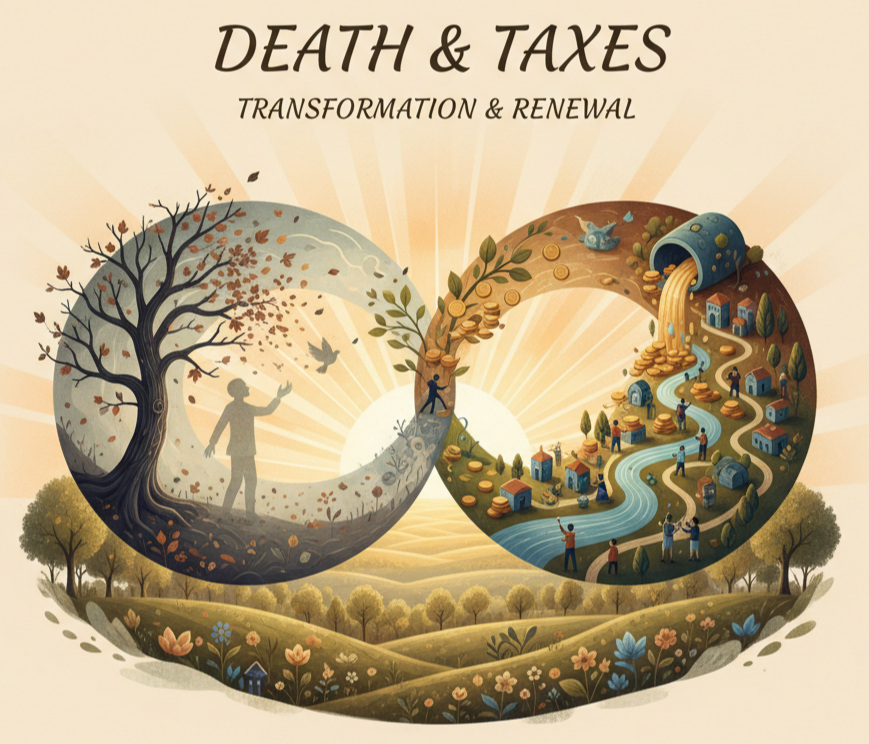
"The only certainties in life are death and taxes" or so the saying goes. They are framed as twin problems forced upon us. No matter what you do you cannot escape either.
Since our Prehealing journey is about addressing every concern, every issue and every disease that makes us uncomfortable, the least we can do is to look into these two inevitable realities of life and see as to how we can treat this affliction.
Let’s start with why we fear them.
We fear death because it is the ultimate unknown. It happens to everyone, yet it remains a process we rarely study or contemplate. We don’t want it, we can’t escape it, and our inability to imagine existence beyond our current form fills us with dread.
Similarly, we fear taxes because they feel forced upon us—an obligatory levy where avoidance leads to punishment. The common thread? Both feel imposed, inescapable, and contrary to our desire for autonomy.
But is death truly what we think?
Death is not merely a singular event at life’s end. It is a continuous transition. From a cellular perspective, our cells die every day. Our organs are entirely replaced over months and years—even neuronal cells replace their material. We are constantly dying and renewing, yet we don’t mourn this daily death.
Why?
Because there is a replacement.
To put it in context. Consider my eldest son.
The three-year-old boy I cherished, whose photos fill an album, no longer exists in that form. He is now twenty five, with different bones, hair, and mind. However, I do not grieve the loss of that three-year-old. I do not cry because he is no more. I do not miss him and hold that image close to my heart waiting for him to return.
Why?
Because I have gained a new person. Life kept giving me a replacement. The three year was left far behind, was dead long ago, yet I have my replacement albeit it be a 25 year old completely different form.
And herein lies the reason as to why we never look at albums as graveyards. The continuity of life, blurs the loss and softens the sting of these smaller “deaths.”
To embrace death is not to seek suicide, but to observe it and realize its importance. Acknowledge the cellular apoptosis that happens every minute—a process so vital that without it, we would develop cancer. Cells self-destruct to keep the whole organism healthy. Every end is also the start of a new beginning. Our infancy ended with becoming a child. The innocence of childhood faded as we moved into teenage and gradually into adult hood. The freedom of being single died down as we created a family. Each end was the death of something we had been yet a beginning of something equally beautiful.
Death is something that we are continually experiencing every moment, yet surprisingly we do not see it as death. As the clock ticks, every second dies to be replaced by a another and the cycle continues, Days fade away, weeks pass, seasons change, years roll on ushering new eras, old memories are replaced by new ones and in the same way,one day we too would shed our body so as to make space for new generations. Death is the phenomenon we observe as life nudges on, as it moves ahead ushering new possibilities, unveiling new opportunities and creating new experiences. We couldn't be in this moment if not for death. Death is what makes life possible. It is Life's shadow. Without life, death would not be possible and without death, life would be impossible!
By observing and accepting this, we stop shunning death and start living more fully in each moment. The key is surrender—to the cycle, not to despair.
With death defanged, can we now use the same approach to get over our fear of Taxes too
Here we go...
A different perspective and Take on Taxes:
If death is a healthy part of change and life, taxes, in a surprising way, follow a similar pattern. We pay taxes constantly, often without realizing it. With every purchase of food, medicine, or cosmetics, a tax is embedded. Even in places dubbed “tax-free,” there is a cost—the “tax” of production, of supply and demand, of nature’s own limitations when resources are scarce. If the government doesn’t claim a share, an agent, a manufacturer, or the very forces of the market will.
The strain we feel while parting with our money is less about the transaction and more about our perception: the belief that we are being deprived of what is rightfully ours.
This leads to the core question: What is truly “ours”? We hold onto money with a ferocity that often surpasses our regard for well-being. Money itself has no intrinsic value; we assign it value. Contrast this with a coconut, a car, water, or air—these have inherent, survival-based worth. Yet, we hoard money like squirrels, burying it away, sometimes to the point of absurdity. There are accounts in banks, untouched for years, belonging to those who have passed away. I’ve known people who would rather lose their life than spend their savings on healthcare. This obsession with money makes us view taxes as a robbery of our happiness.
What if paying taxes was not negative, but a source of healthy stress? When I lose money to taxes, it creates a potential—a drive to earn more. High tax rates have spawned entire professions: chartered accountants, tax consultants, financial advisors, funds, investment opportunities.... The struggle to save tax has built industries.
Tax creates dearth; dearth awakens motivation; motivation creates movement; and movement is life.
Taxes, when paid, support the ecosystem we live in—the roads, the infrastructure, the community. By paying, we belong. We contribute. We build, nurture and sustain not just the economy, but the social fabric and the network that we are a part of.
Here is a peek into the thoughts I entertained:
What would I lose if I were to pay taxes willingly, without complex evasion? I would save myself the stress of hiding money, the fear of being caught, the burden of “black money.” A small, accepted strain could now replace a mountain of anxiety and unintended consequences.
Moresoever, I would be able to prove to myself that I am worthy of paying taxes. Of supporting others who are not as blessed, fortunate or capable as I am. I would be able to play the role of a family member. Support my family and fulfill my Dharma.
So I set myself a goal: how can I pay more taxes? Gradually work on my ability to pay more taxes. Yes it would be taxing, because to pay more taxes, I need to work harder and earn more. Nevertheless if paying tax can be an enjoyable experience it is a win win scenario.
So you see, taxes need not be taxing at all!
We can choose to see tax payments as a badge of pride. Tax payment can be looked on as a certificate of achievement of personal win. What if we made it a friendly competition? Who can pay more taxes for the common good? This mindset could transform an obligation into a mission.
By embracing the dreaded tax, it can be transmuted into an empowering opportunity.
But is tax just about paying money to the government. Surprisingly this philosophy extends beyond money.
“Tax” is any form of strain or stress that strengthens us. As I write this, I’m walking in the cold at 3 a.m., in just a tee-shirt and shorts. The chill taxes my body. Waking early taxes my will. The walking strains my muscles. But by embracing this discomfort, I adapt. When the body gets taxed, I reap the benefits.
We go to the gym to tax our muscles—they break down to rebuild stronger. We take exams to tax our brains—stress for the sake of growth. We expose our immune system to pathogens—not overprotecting it with antibiotics—so it learns, adapts, and becomes resilient.
Taxing leads to strength. Taxing leads to adaptation. Taxing leads to holistic health, balance, and integrity. If this is true for our bodies and minds, why not for our finances? Monetary tax, then, becomes a gym for our societal and economic vitality. It builds resilience in the system and in ourselves.
So, let us re-frame the old adage.
It is no longer about “Death and Taxes” as dreaded inevitabilities.
It is about "life and Sacrifices"!
The conscious embrace of necessary strains that lead to growth, renewal, and a more holistic existence. By changing our perception, we transform the inescapable into the instrumental. We stop clinging to valueless money and start investing in a valuable life. We stop fleeing from death and start living in harmony with its rhythm.
When the thought of death no longer taxes us and when taxes don't seem to be a financial death sentence, only then can we utilize these two powerful realities for our own growth, wellbeing, happiness and prosperity.
P.S: And yes, writing this blog was taxing, but I realized that I did not kill my time, I made my life worth living for myself as well as for you :)
Comments