
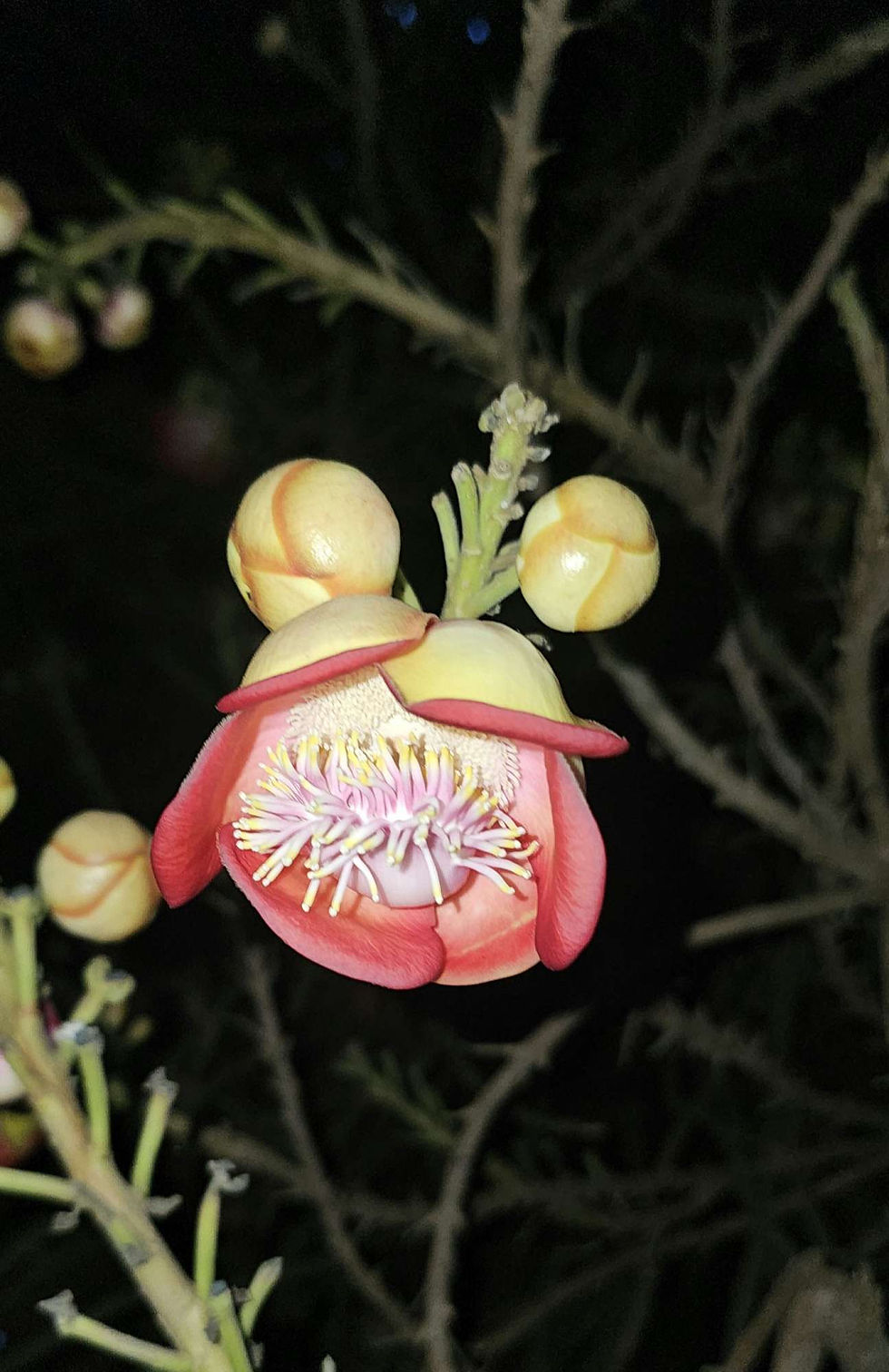
Couroupita guianensis (Leythidaceae) Naga Champa
Updated: Nov 30, 2025
Couroupita guianensis (Cannonball Tree)
1. Scientific name and Basic Taxonomic classification
Species: Couroupita guianensis
Family: Lecythidaceae
Genus: Couroupita
Related Herbs from the same family:
Barringtonia acutangula (Indian Oak/Hijjal): A tree found in wetlands, used in Ayurveda and Siddha medicine for its antipyretic, anti-inflammatory, and anthelmintic properties. The leaves and bark are used for fevers and joint pain.
The Lecythidaceae family is a tropical family of trees, many of which have showy flowers and medicinal properties in their bark and leaves.
2. Common names
Scientific Name: Couroupita guianensis | English: Cannonball Tree | Sanskrit: Nagakeshara, Shivalinga, Naga Champaka | Hindi: Nagalingam, Shiv Kamal | Tamil: Nagalingam | Telugu: Nagalingam | Kannada: Nagalinga | Malayalam: Nagalingam | Marathi: Nagalinga | Bengali: Nagkeshar | Sinhala: Sal | Thai: Sala |
3. Medicinal Uses:
Antimicrobial,Antifungal, Antibacterial, Analgesic (pain-relieving), Anti-inflammatory, Antipyretic, Antiseptic.
Medicinal Parts:
The flowers,bark, leaves, and fruit pulp are used in traditional medicine.
Flowers: Used for skin diseases and colds.
Fruit Pulp: Applied topically.
Bark and Leaves: Used in decoctions and poultices.
4. Phytochemicals specific to the plant and their action.
Couroupitine (a unique compound): Isolated from the plant, it has demonstrated potent Antimicrobial and Antifungal activity.
Tannins and Flavonoids: Their actions are Astringent, Antioxidant, and Anti-inflammatory.
Triterpenoids (e.g., Betulinic Acid): Known for their Anti-inflammatory and potential Anticancer properties.
Alkaloids (Indole Alkaloids): Contribute to the plant's Analgesic and antimicrobial effects.
Sterols (e.g., Sitosterol): Exhibit Anti-inflammatory and Antipyretic (fever-reducing) actions.
5. Traditional and Ethnobotanical uses covering the Medicinal uses.
Vrana (Wounds) & Kushtha (Skin Diseases)
Formulation: Juice of leaves or flowers.
Preparation & Use: The juice is applied directly to wounds, skin infections, and fungal conditions like ringworm. The bark is also used as a wash for skin diseases.
Reasoning: The potent antimicrobial and antifungal properties help prevent infection and promote healing.
Jwara (Fever) & Shoola (Pain)
Formulation: Bark decoction.
Preparation & Use: A decoction of the bark is consumed to reduce fever and relieve internal pain.
Reasoning: The antipyretic and analgesic properties of the bark help lower body temperature and alleviate pain.
Kasa (Cough) & Swasa (Asthma)
Formulation: Flower juice or decoction.
Preparation & Use: The juice of the flowers is taken with honey to relieve cold, cough, and asthma.
Reasoning: The flowers are believed to have expectorant and bronchodilatory properties, helping to clear respiratory passages.
Arsha (Piles) & Gudadaaha (Burning Sensation in Anus)
Formulation: Pulp of the fruit.
Preparation & Use: The pulp of the unripe fruit is mixed with other herbs and applied topically to relieve the pain and swelling of hemorrhoids.
Reasoning: The anti-inflammatory and analgesic properties provide localized relief.
6. Healing recipes, Teas, Decoctions and Culinary use (if any):
This tree is primarily used for medicinal and religious purposes, not as a food source.
Nagalingam Flower Juice for Cold and Cough
Purpose: To relieve respiratory congestion.
Preparation & Use:
· Crush a few fresh flowers to extract the juice.
· Mix with a teaspoon of honey and consume twice a day.
Bark Decoction for Fever and Pain
Purpose: To reduce fever and alleviate body aches.
Preparation & Use:
· Boil a small piece of bark (about 10g) in 2 cups of water until it reduces to 1 cup.
· Strain and drink 1/4 cup twice a day.
Leaf Paste for Skin Infections
Purpose: To treat ringworm, itching, and wounds.
Preparation & Use:
· Grind a handful of fresh leaves into a fine paste.
· Apply topically to the affected area and leave for 30 minutes before washing.
7. Disclaimer:
Couroupita guianensisis a powerful medicinal plant. The fruit pulp is considered inedible and can be toxic if ingested. Internal use of bark or other parts should be done with extreme caution and only under the supervision of a qualified practitioner, as the active compounds are potent. This information is for academic and educational purposes only and is not medical advice.
8. Reference Books, Books for In-depth Study:
· Indian Materia Medica by Dr. K.M. Nadkarni
· The Wealth of India
· Siddha Materia Medica
9. Further study: Plants that might interest you due to similar medicinal properties
1. Mesua ferrea (Nagkesar)
* Species:Mesua ferrea | Family: Calophyllaceae | Genus: Mesua
* Similarities:This is the classical "Nagkeshara" of Ayurvedic pharmacopoeia. Both plants share the name and are used for bleeding disorders, skin diseases, and their strong aromatic, astringent properties. They are often confused due to the common name.
2. Barringtonia acutangula (Indian Oak)
* Species:Barringtonia acutangula | Family: Lecythidaceae | Genus: Barringtonia
* Similarities:As a member of the same family, it shares similar traditional uses for fever, inflammation, and skin conditions, highlighting the medicinal potential of this plant family.
-x-x-x-End-x-x-x-

Comments